

The National Civil Rights Museum, Memphis
Updated: Sep 8
450 Mulberry St., Memphis, TN 38103
(901) 521-9699
Open Mon, Wed-Sun 9am to 5pm and closed on major holidays. Free for Tennessee Residents after 3pm on Mondays.

I remember the first time I saw the National Civil Rights Museum in Memphis. We had parked the car and were heading towards a restaurant when we rounded the corner, and right there in front of us was the Lorraine Motel. I let out an audible gasp. It is impossible to see the neon sign and not feel a wave of emotions, as pictures of Jesse Jackson, Ralph Abernathy and the slumped body on the motel balcony assault the mind. It was a dreadful day when Dr. Martin Luther King, Jr. was killed, considered among the worst in modern US history. I was so overcome seeing the motel that I could not get the events that transpired there out of my mind. And perhaps that’s exactly why this place HAD to be made into the National Civil Rights Museum. It is a monument to one of the greatest leaders our country has ever had, and a tribute to his and many others’ efforts for social and racial equity.

The National Civil Rights Museum in Memphis, TN 
The Lorrain Motel, just as it was the day MLK, JR died 
The site of Dr. King's death, the Lorrain Motel, has become the National Civil Rights Museum
Imagine you are tasked with creating an exceptional Civil Rights Museum. What a mammoth endeavor, an undertaking that must have truly taken so much thought and consideration! There’s a lot to unpack, and it would be easy to be heavy-handed. At the same time, if you don’t make people think, or cry, then what is the point? The story of Black people in America is an important one to tell, and using the setting of the Lorraine Motel is a stroke of genius. What better place, really? Tennessee should be incredibly proud to have this museum in Memphis, the city itself a Civil Rights Sacred Site of epic proportions. Through great vision they set aside this historic landmark, and with the help of brilliant leadership and staff have created an immersive experience through interactive exhibits and films. The NCRM not only brings the past to life but also elicits the key questions of why the struggle for equality and freedom are still out of reach for so many.
“Freedom is never voluntarily given by the oppressor; it must be demanded by the oppressed.” – Dr. Martin Luther King, Jr.

A garment like this would have been worn by slaves coming from Africa 
A statue of a woman and her infant are being sold 
A wall of freedom fighters and abolitionists at the NMCR
We visited the museum on a Monday, taking advantage of the free entrance for Tennessee residents after 3 pm. We were there three hours and could easily have used at least another hour, preferably two, although it could take more. The tour begins with the history of slavery of the African people in the Americas, and continues to the present-day struggles for voting rights, equal pay and fair representation including LGBTQIA+ and Women’s issues, housing and education. For those who are expecting a museum dedicated to MLK, Jr., know up front that’s not all you’ll get, for to truly appreciate his life and death it’s important to understand the story of the human and civil rights movement before he came along, and the work that remains. It is then you may better grasp how Dr. King and his death changed the trajectory of history in ways that are still felt today.

The Klu Klux Klan, portrayed in the National Civil Rights Museum A statue of Rosa Parks ignoring a bus driver at the NCRM 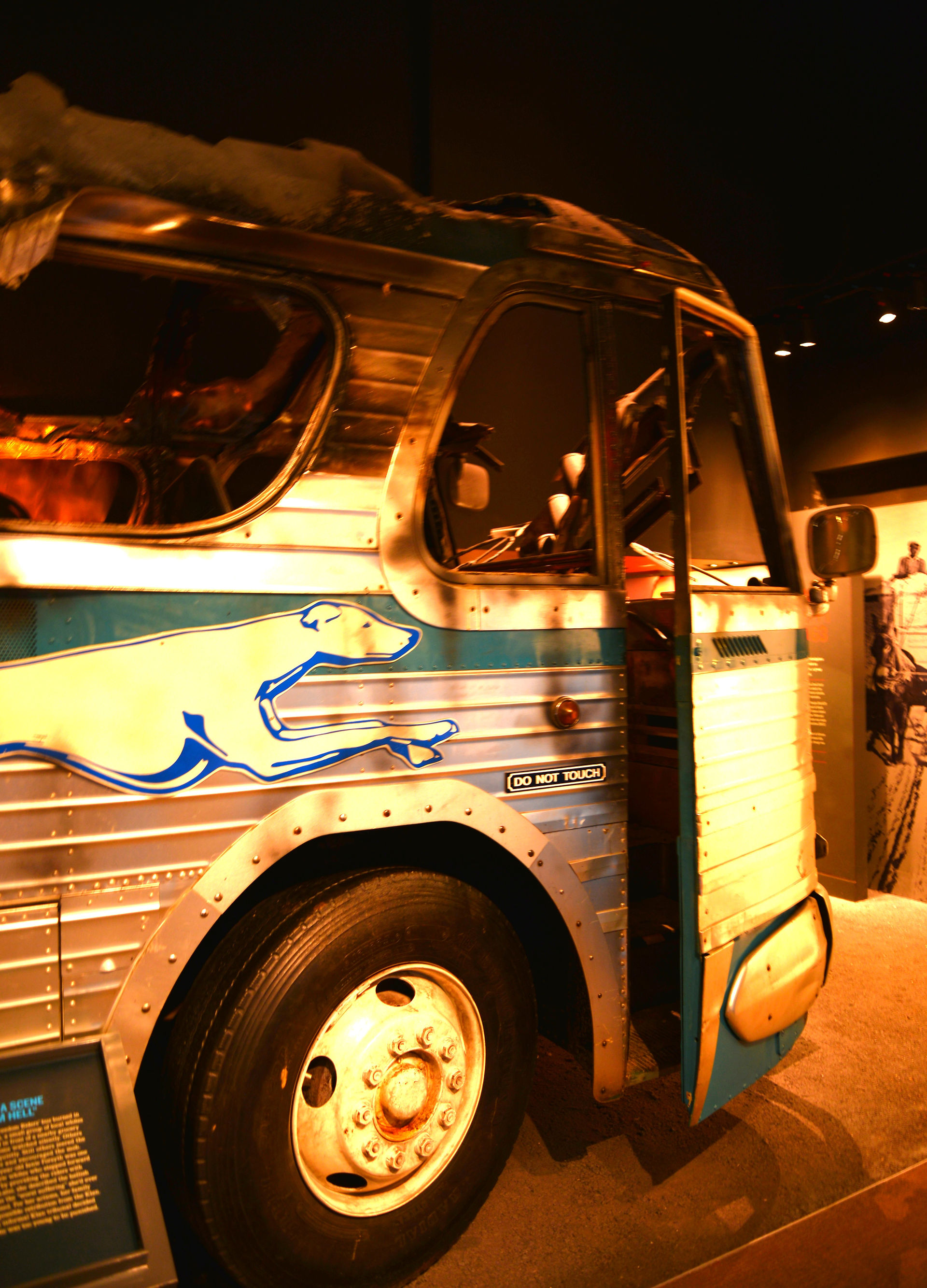
A burnt out bus like the ones the Freedom Riders were in at the NCRM 
A garbage truck like the ones ridden by trash collectors in Memphis prior to the strike, at the NCRM
The experience was heavy and deep, and so many stories were considered. After all, it was not just those who emerged as leaders but everyday people who struggled, suffered and gave their lives, as well as those who succeeded against all odds. There were great pictures and multimedia exhibits that engaged your mind and emotions; for example, one exhibit considered the history of lynching, both before the Civil War and afterward (and tragically continues still), but also physical artifacts like the bus that Rosa Parks would have ridden (with a statue of her seated inside, ignoring a shouting bus driver to get up and move), a burnt out bus ridden by the Freedom Riders, and a garbage truck the sanitation workers used in the famous Memphis protests (the truck body cleverly used as a projection screen of news stories from the time). I learned about the Black newspapers that arose out of Jim Crow that gave pride to literacy and education and fueled the protests born from outrage.
“All we say to America is, ‘Be true to what you said on paper.’ If I lived in China or even Russia, or any totalitarian country, maybe I could understand the denial of certain basic First Amendment privileges, because they hadn’t committed themselves to that over there. But somewhere I read of the freedom of assembly. Somewhere I read of the freedom of speech. Somewhere I read of the freedom of the press. Somewhere I read that the greatness of America is the right to protest for right.” - Dr. Martin Luther King, Jr.

A replica of a lunch counter protest at the NCRM 
Protestors at a lunch counter fighting for desegregation
To me, one of the most moving exhibits was a replica of a lunch counter sit-in like those waged in Nashville, Greensboro and elsewhere. Behind figures of four seated protesters, with two white men jeering and threatening them, played newsreel footage of the awful violence perpetrated upon brave activists who chose this path. In fact, there was a lot of space in the museum dedicated to the non-violence movement, modeled in part after Mahatma Gandhi's efforts in India. He believed that this path took more courage and strength than did brutality, because retaliation is the low road that only grows more violence. In Nashville, we are often reminded of Rev. James Lawson, Diane Nash, John Lewis and Bernard Lafayette who launched the lunch counter protests here to desegregate downtown shopping and restaurants, frequently enduring beatings and other violence at the hands of white mobs. There was also the terrible bombing of Z. Alexander Looby’s home, a prominent Black lawyer who often represented these students and other activists. A march to City Hall after this tragic event by African Americans led by Diane Nash saw the Mayor of Nashville, Ben West, agree to work towards ending Jim Crow. Seeing a section on the success of the non-violence movement in Nashville made me appreciate once again the sacrifice of these student leaders. Their success would spur sit-in protests in Atlanta, Birmingham and other cities.
“Nonviolence is absolute commitment to the way of love. Love is not emotional bash; it is not empty sentimentalism. It is the active outpouring of one’s whole being into the being of another.” - Martin Luther King, Jr.
The Non-Violence Ethic:
I hereby pledge myself, my person and body to the non-violence movement. Therefore, I will keep the following Ten Commandments:
1) Meditate daily on the life and teachings of Jesus.
2) Remember always that the non-violent movement in Birmingham seeks justice and reconciliation, not victory.
3) Walk and talk in the manner of love, for God is love.
4) Pray daily to be used by God in order that all men be freed.
5) Sacrifice personal wishes so that all men might be freed.
6) Observe with both friend and foe the ordinary rules of courtesy.
7) Seek to perform regular service for others and for the world.
8) Refrain from the violence of fist, tongue or heart.
9) Strive to be in good spiritual and bodily health.
10) Follow the directions of the movement and the captain on a demonstration.
I sign this pledge, having seriously considered what I do and with the determination and will to persevere.
But many African Americans saw weakness in this movement and would not tolerate another minute of harassment or senseless death at the hands of white supremacists and bigots. Separatist movements ran alongside the non-violence movement and took on great power in Black communities, starting with the Nation of Islam in the 1930’s which would give rise to powerful leaders Elijah Muhammad and Malcolm X. During the height of the Civil Rights protests, the militant Black Panther movement in the 1960’s led by Huey Newton and Bobby Seale would unapologetically use the threat of brutality to challenge the excessive force and misconduct of the Oakland Police Department. (And were the Black Panthers truly the “monsters” they were portrayed as when the work in their communities made a positive difference? Work that was done to feed children, fight for decent housing and keep people safe?) The opposite approaches of non-violence vs. Black Power had different results, which brought both empathy and fear to the hearts of white America.
"If white people see what the alternative is, maybe they'll be more willing to hear Dr. King." - Malcolm X, speaking to Coretta Scott King while her husband was in jail, February 1965.

There are often sections in the museum that dissect the response of both state and national governments to the breakdown of Jim Crow, the protests small and large, the effects of integration and desegregation, and attempts for voting rights and human dignity. It’s important to remember that the government response, or lack of it, played a huge role in the fight for Civil Rights. I also appreciated that the museum acknowledged the white volunteers and protestors who included not just every day men and women, but also Protestant and Catholic clergy and Jewish rabbis who laid their lives on their line for the injustice they could not tolerate. Truly, these people heard the words of Dr. King and followed the love in their hearts. It was finally time to acknowledge that all men ARE created equal and deserve to be treated as such.

Dr. King and others, including white clergy and rabbis, march for justice. Picture uncredited NCRM 
Statutes of protestors in front of a pic of actual ones, NCRM 
The famous slogan from the Sanitation Workers strike, brought to life at the NCRM
Let us not forget that the NCRM is located at the Lorraine Motel, and this brings a whole other dimension to the experience. It isn’t until the end of the tour that you must confront the assassination of Dr. King and the nation’s response to his murder. Artfully presented and engaging, you can almost feel yourself there, at that time, reliving the horror of the moment through news broadcasts and the emotions of those who were so devastated.

The balcony at the Lorraine Motel where MLK, Jr. was assasinated. 
The room Dr. King's assassin stayed at, across from the Lorraine Motel 
The Legacy Museum of the National Civil Rights Museum, with a view of the Lorraine Motel. 
The spot where Dr. King died in the Lorraine Motel
A touching and surprising aspect of the museum is how the rooms were preserved where MLK, Jr. stayed; how you can view the balcony where he died not just from the street looking up, but also from the inside looking out, and most surprising, from the building where the gunman took his shot – now the Legacy Museum. You see the actual hotel room where the killer stayed, and the bathtub he stood in to get the perfect angle - a unique and unsettling perspective. Was it really Jack Ruby who pulled the trigger? A well thought out investigation into many details I had personally never heard before is presented. Does the evidence truly implicate him? Who are the other suspects, and did our government conspire to hide the truth?
“I believe that unarmed truth and unconditional love will have the final word in reality. This is why right, temporarily defeated, is stronger than evil triumphant.” - Martin Luther King, Jr.
So much to think about in this museum. You may think you know the story behind MLK, Jr. and the Civil Rights movement, but once you’ve experienced these exhibits you’ll come away with a much deeper and sympathetic understanding, one you will never forget. You may find yourself asking, how much has changed since Dr. King passed? How far have voting and human rights issues come since his death, or have they regressed? If you are non-Black, has your empathy towards African Americans increased now that you have a better understanding of their history? In the end, the National Civil Rights Museum must make you ask the hard questions, or the subjects and the sacrifice of many would be lost to time.

If you’ve read a previous post about Collins Chapel CME Church, you’ve learned a smidgeon about the racially divided history of Memphis, which is harsh, complex and quite charged and ultimately brought MLK, Jr. to the area. It is his violent death, here in Memphis, that would truly underscore the struggles of Black people to an international audience, helping to bring about hard-fought change. Of course, Dr. King was a man, and he had his own failings, and the museum does not seek to make him a saint, but rather a man who chose Love For Everyone above his own needs. And Dr. King had a precognition he would die violently but was willing to martyr himself for the greater good. The site where that happened was here, at the Lorraine Motel, and if that doesn’t make this a Sacred place, I don’t know what does.
I also highly recommend a visit to the downtown Public Library in Nashville, TN for the Civil Rights Room which has an outstanding amount of information and exhibits!


Comments