

Egyptian Marvel: The Downtown Presbyterian Church, Nashville
Updated: Jun 23
154 Rep. John Lewis Way, Nashville, TN 37219
615-254-7584
Tours every 4th Friday of the month from 12pm-2pm.

WARNING: You’ve never seen another church like this one, nor are you likely to ever again. This is more than a church. This is Eye Candy. Coffee table book material. A gorgeous work of art that shouts and swaggers! How can one church be so stunning? So dignified yet brazen in its glory? If you have dreams of going to an Egyptian temple, or recall one from a past life, the Downtown Presbyterian Church in Nashville, TN is a Sacred Site you must see!

Don’t just take my word for its beauty! The Downtown Presbyterian Church has garnered a great deal of national attention for its design. Many experts feel it is one of the finest examples of Egyptian Revival Architecture in the United States and is the best of the remaining ecclesiastical examples. It has been designated a National Historic Landmark and is listed in the U.S. National Register of Historic Places. So, this place is rare, spectacular, and very, very special.

The incredible Egyptian Temple details of the Downtown Presbyterian Church, Nashville TN 
An artist's cross, one of many art pieces in the Downtown Presbyterian Church
Let’s dive into the incredible design of the church, because there is so much to see here!
When Napoleon’s campaign of 1798-1799 to Egypt brought back exotic images of what they found, a fever for Egyptian artifacts and design swept through the world. People simply could not get enough of the astonishing colors, ornamentation and details, and soon architects and artisans were busy drafting to replicate these motifs in buildings, furniture, jewelry, and even churches. Churches?! Churches and temples worship different Gods, do they not? How do you reconcile the monumental artistry of ancient Egypt and its polytheistic beliefs with the solid countenance of Christianity and monotheism? Margaret M. Grubiak in her study of Egyptian Revival architecture believes that Americans chose to change the meanings of Egyptian forms for their own purposes, substituting Christian for pagan connotations to define a new spiritual world. (Here are some books on the subject.*) But doing this on a large scale is no easy task, and only a few architects and congregations attempted Egyptian Revival when it came to building churches. So how did this church come to be created in Nashville, and by who?

The palms of Egypt decorate a Presbyterian Church in Nashville 
Egyptian details can be found throughout the Downtown Presbyterian Church 
An Egyptian Temple in Nashville, TN! 
Pres Polk once worshipped at DPC 
Egyptian palm trees in stained glass 
Columns are dramatic backdrops
According to church historian Jim Hoobler who coined the phrase the “Karnak of the Cumberland,” the site was originally named First Presbyterian Church, and it was one of the first churches built in the city in 1814; however, after devastating fires in 1832, and again in 1848, a rebuild was necessary. As luck would have it, famed architect William Strickland had come to Nashville from Philadelphia in 1845 to design the Tennessee state capitol which he created in the Greek Revival style. Steeped in classic design, Strickland was considered the most important architect to have lived in Nashville, the Athens of the South, and he was asked to submit a plan to replace the burnt First Presbyterian Church. He started with Italianate design, but with tepid response he went back to the drawing board. Fascinated by the Egyptian illustrations being published by scholars and artists, Strickland created the blueprint for the church, which was surely controversial for its time. There must have been great discussion among the parishioners as to mixing the beliefs of the Presbyterians with replicas of the great Temple of Karnak; of combining the winged sun disk of Ra and stained-glass windows of palm trees with Christian themes of crosses and organs. Luckily, the vision of those willing to take a design risk won out and Strickland’s design was completed by 1851. Then a rift in the church nearly destroyed it. When many practitioners wanted to move to the suburbs in 1955, they took the First Presbyterian name and nearly everything else as well. The downtown location was slated to become a parking lot, but the remaining congregation rallied, securing the funds to keep it going and renaming their congregation The Downtown Presbyterian Church, thereby saving the unique architecture.

Unfortunately, a shortage of funds meant that while the interior elements were fantastic, the colors were not (it was mostly grey). It took 30 years to raise the money and find the people to create the church you see today. It wasn’t until the 1880’s when two decorative painters would be hired to bring the church to life with color. Theo Knoch and John Schliecher were German artists who had recently completed the fresco paintings at the capitol, and they must have been very excited by the project in front of them. Soon the symbols, patterns and colors seen in Egypt were lovingly crafted, including stunning floor-to-ceiling trump l’oeil paintings, stenciled walls, and canvas ceiling panels that recreated the Egyptian sky. The ceiling alone uses 16 different colors!
Some of the symbols you are likely to see are the Winged Sun (a symbol of divinity, power and protection); lotus flowers (symbolizing rebirth and purity); and columns resembling the Djed forms (representing stability and linked to Osiris, God of the Underworld).
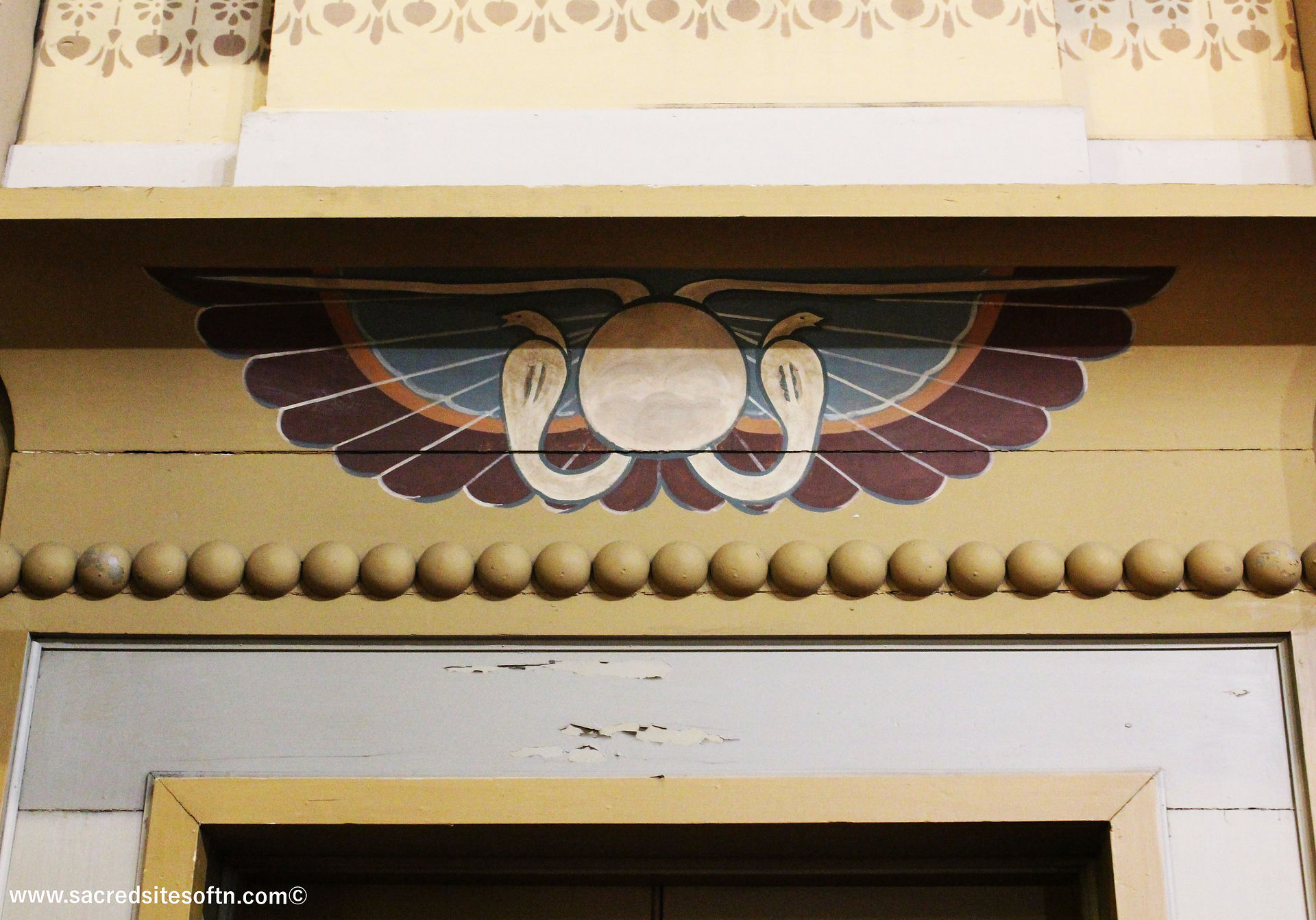
The Winged Sun symbol graces a doorway 
Columns with Djed forms linked to Osiris at the Downtown Presbyterian Church 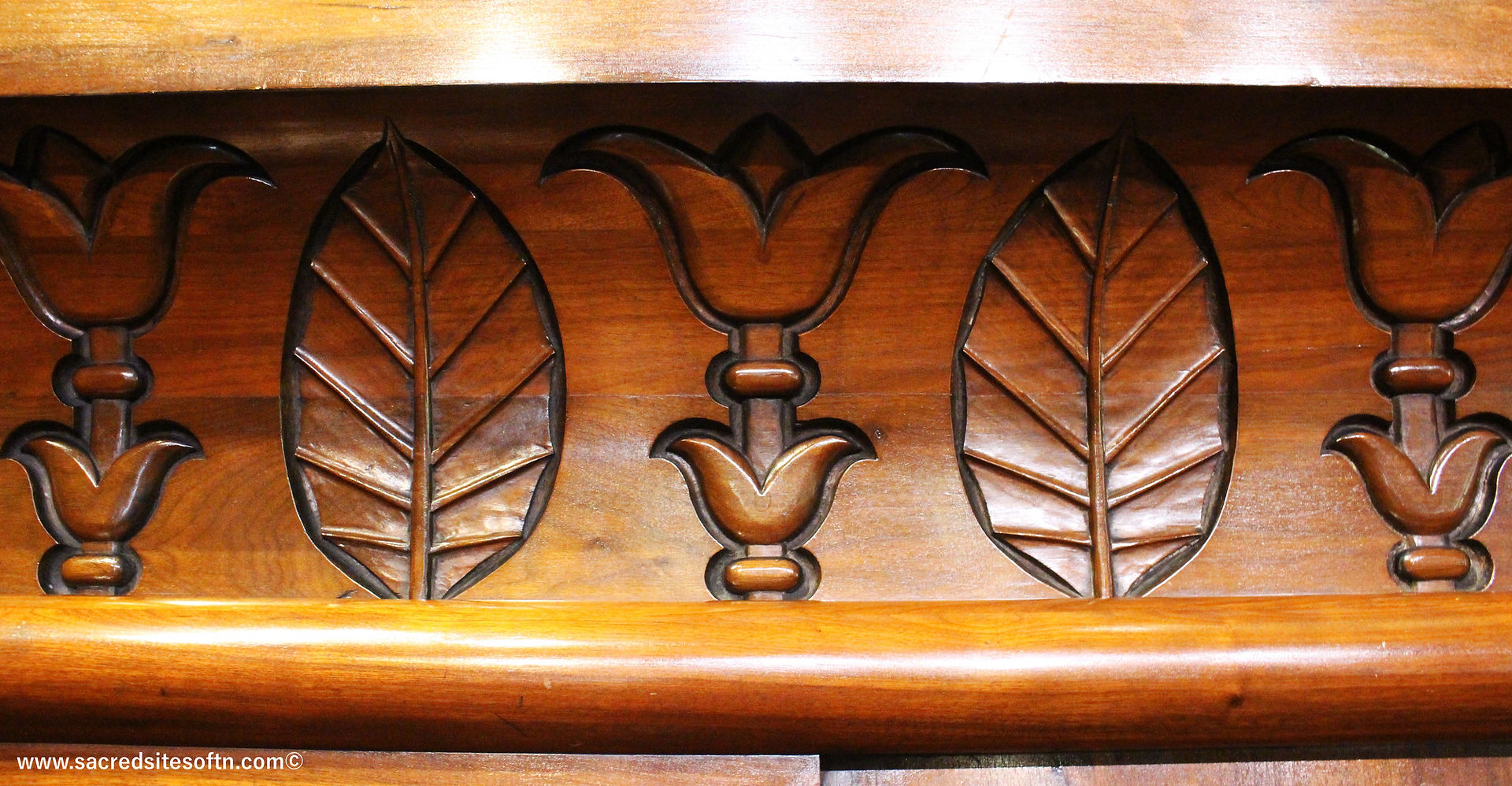
A lotus flower represents rebirth and purity
Another standout feature is the enormous pipe organ. According to the church website the original organ purchased in 1858 was removed by the Union Army during its occupation of the church. In 1874 the decision was made to replace the second organ (in the balcony at that time) with a grander organ to be placed in the Sanctuary. This was enlarged in 1913 and again in 1972 by Austin Organ Co. and Milner Organ Co., and the grand total of pipes is now an astonishing 2,709! I was invited to access a secret door to crawl beneath the organ to see the bellows and wooden pipes; it was amazing! (I barely made it through the door. Only small people need apply for this job.

The massive organ at the Downtown Presbyterian Church, Nashville TN 
The organ keyboards 
A songbook at DPC, Nashville 
The organ components under the stage 
The bellows of the organ 
The Austin Organ Co. sign
A chapel located behind the Sanctuary is also a must-see. The beautiful blue and white room is so sunny and inviting and seems like a private, inner sanctum; another reason to visit this gorgeous church if you get the chance!

The chapel in the Downtown Presbyterian Church 
The chapel in the Downtown Presbyterian Church
The Downtown Presbyterian Church also plays an important role in Nashville history from some of its earliest days as a city. The church was the site of services for two men who would become President of the US: one for General Andrew Jackson when he was presented a ceremonial sword after the successful Battle of New Orleans, and in 1832 for the inauguration of James K. Polk as Governor of Tennessee. During the Civil War it became a military hospital for Union forces, and it housed soldiers during WW2 practicing maneuvers for what would become D Day and the Battle of Normandy. Mrs. James K. Polk, before she became First Lady of the Nation and was First Lady of Tennessee, secured her favorite seat in a pew directly behind Adelicia Acklen, who was one of the wealthiest women in the U.S. in the 1800's. (You can see my pictures of Acklen's stunning crypt at Mt. Olivet Cemetery in this post.) The room between the Sanctuary and the Chapel has pictures and items from the church's history that are pretty interesting to see, including a bible that survived the fire of 1832 that destroyed the church, and another beautiful stained-glass window.

A portrait of Adelicia Acklen 
A bible survives the fire 
Much of Nashville's history is reflected in the history of the church 
Famous people and ministers of the DPC 
Unique stained glass windows decorate the church in Egyptian themes 
Old typewriters used more than a century ago
The upstairs balcony has a fabulous view of the Sanctuary below, and its seating are called Opera chairs that include wire fixtures under the seats for top hats! From here you have a superb view of the ceiling tiles that are meant to convey the skies in Egypt, and a close-up view of more stencils and stained-glass windows. Interesting notes: The stairs leading to the balcony are covered in leather, and the rope to ring the church bell is located here.

The bell tower and leather stairs 
View from the balcony 
Coffered ceilings mimic the Egyptian sky 
Chairs from an opera house in the balcony 
Stained glass window with palm trees
You can find a number of art installations at the church, and Artists-In-Residence are regularly invited to exhibit. A permanent exhibit is a statue of Jesus sculpted by Puryear Mims. Originally in plaster, it was made into the metal piece we see today by Mims’ student Alan LeQuire. This is the famous Alan LeQuire, who also created Athena for The Parthenon in Nashville's Centennial Park. Artists-In-Residence are regularly invited to exhibit.

Statue of Jesus by Alan LeQuire 
Art instillation in Downtown Presbyterian Church, Nashville TN 
One of many art instillations in Downtown Presbyterian Church Nashville TN
The church plays organ music after every service (which must be amazing to hear!) and has an active participation in helping the homeless by serving hot meals every Wednesday for lunch and Sunday for breakfast. It provides an office for The Contributor, and helps other non-profits such as Open Table, Matthew 25, Monroe Harding Children’s Home, Siloam Clinic and Room In The Inn. Please consider a donation to support the upkeep of this important and historic building when you visit.
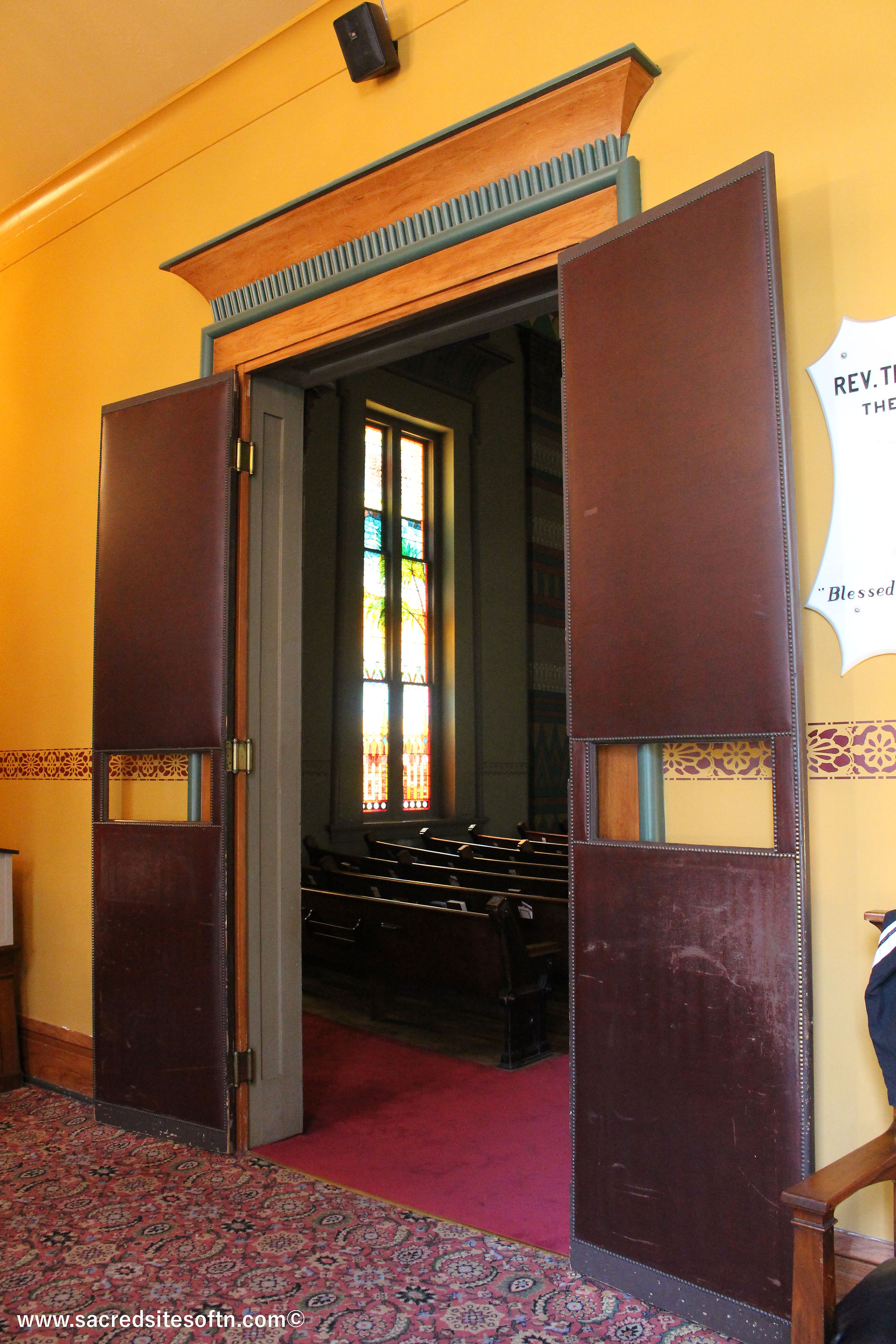
Doors lead to the sanctuary at DPC 
An Egyptian themed lamp 
Historic plaques in the DPC
The Downtown Presbyterian Church is on the corner of Rep. John Lewis Way and Church Street and offers a tour of the church every fourth Friday of the month from 12pm-2pm. At the church you can grab a flyer with a QR code that provides a video by the church historian Jim Hoobler, who discusses the history of the church and describes the space within. I had a great tour guide, Michael Atwood, who is a church member and was very knowledgeable and enthusiastic about his beautiful church, and it made the visit even more enjoyable. If you go, please let me know what you think about your experience!

*As an Amazon Associate I earn from qualifying purchases. If you are interested in Egyptian symbols and Egyptian Revival Architecture, please consider purchasing books using my link so that I can keep this blog going!


Comments