

The Mindfield Cemetery: Death + Art = Life

If you like this post, please like, comment, share and subscribe to Sacred Sites of Tennessee so that others will see it. Thank you!
The Mindfield Cemetery, Brownsville
344 W. Main St., Brownsville, TN 38012
Located in the west side of downtown Brownsville on West Main St./Hwy 54, near the Haywood County courthouse. Park in the lot behind the Food Giant, or view from across the street or the cemetery. NOTE: This is PRIVATE PROPERTY. Please respect Mr. Tripp’s privacy and that he is a working artist. If you are respectful, he may allow you to wander around.

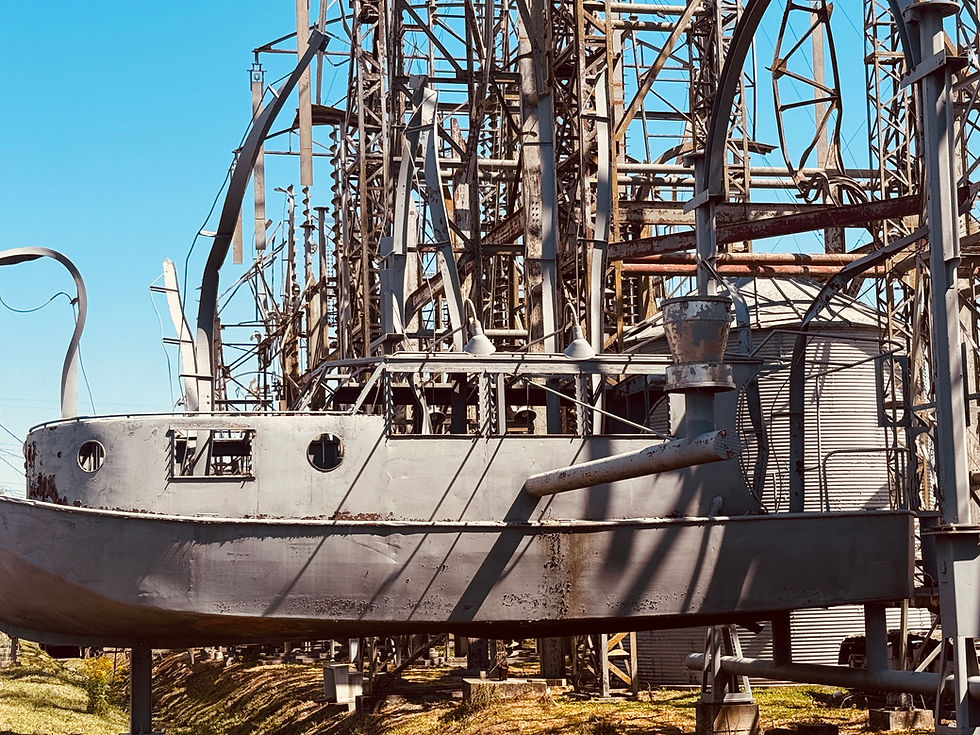
The Mindfield Cemetery is one of the most original, moving and extraordinary artscapes ever constructed, and by a remarkable artist. At a half an acre wide and 127 feet tall at its highest point, it is the largest art installation in Tennessee and maybe the whole country, and the best possible yard art on a grand scale. And although this is called the Mindfield Cemetery, it is not one - yet. It is a work-in-progress grave marker for when the time comes. More than that, it is one of the most incredible cenotaphs you will ever see, a stunning memorial and meditation on Death and Life. It is so unique, so complicated and yet so universal, it is probably beyond words. But I’m going to try to write about it, because if you love art, especially Outsider art, and you are fascinated by the creative process you will be blown away by it. It is unquestionably a Sacred Site, albeit one in a most unexpected way.
So where to even start on the Mindfield?
...Begin.

Let’s start with the one-of-a-kind William Blevin “Billy” Tripp, the artist behind this project and a kind, gentle man. With only a college class in welding and the occasional advice from others, Billy is a self-taught welder who found his fascination with metal work early and discovered its potential for his self-expression. With some art education under his belt he began to create, inspired in part by the sculptures of Abstract Expressionist David Smith. In the language of art enthusiasts Billy Tripp’s sensational playground is referred to as Outsider or Folk Art. Tripp has a hard time calling his work art at all. To him this is his work, his calling, his obsession. Since 1987 he has devoted decades to building it, working singlehandedly on the project almost daily during the warmer months, and writing in the winter. His materials are found objects and metal structures, and his inspiration his ruminations and written words.

Billy Tripp, the creator behind the Mindfield Cemetery 
Billy Tripp, the creator of the Mindfield Cemetery 
Billy Tripp, the creator of the Mindfield Cemetery 
Billy Tripp points out one of his life stories in the Mindfield.
Billy is not concerned about what others may think about his work, and that allows him the freedom to take his musings in whatever direction they want to go. This means that Tripp's work can be provocative and often misunderstood. For example, he created a sign that says he is pro-gay rights after hearing hateful speech on a Christian radio show. For years he drove a truck that said Satan Saves. A sign says Welcome to Turdville. For him, these words are a reaction to others’ self-righteous behavior and important reminders to always keep an alternate point of view, but the sentiments have agitated some of the citizens of Brownsville. He finds their reactions fascinating but won’t back down from expressing himself. It's Still America (the name of a doc short he commissioned in 2012), after all; Free Speech is Allowed. Overall, though, he feels the town has been good to him, and certainly Brownsville has benefited from his fame. Tripp has been a resident since the third grade. His father’s status as a Methodist minister and owner of Tripp’s Country Hams means he grew up in a family respected by the community, and this has probably gone a long way to giving him, if not acceptance, tolerance for his “wanderings.”
He is also a writer whose works are complex and mind-altering, often written in a stream of consciousness outpouring that requires more than a cursory glance. His book The Mindfield Years (Billy Pyrene’s Biography of Ned), Vol. 1: “The Sycamore Trees," was started after his mother Mabel’s death in 1977, and here he develops his style of writing that is fantastical, with Billy naming and exploring alter egos of his personality. (The naming of things features prominently in his work.) The setting of the book is the actual field that slopes down from his childhood home towards the cemetery where his folks are laid to rest. This is the place he called the Mindfield, and you can see this field today, steps from where Billy took his concept and made it a reality: a Steel Garden where he could manifest his conversations about death, love, connection, eternity, grief, loss, and celebration. In the Mindfield Cemetery and his books he yearns to reconnect with his parents, just as he ponders deeply who they were as people while reading the letters they wrote to each other.


So y'all come again. Anytime. I mean, I have been missing y'all of late, more than usual. And I would like to say hello. You know. Letters are nice, ---but they don't replace the you & Mom. I really would like a sign. Yeah. I know. If a 120-foot-tall symbol isn't enough of a sign already, what more could possibly be? Amen.---& all of that! Still. - The Mindfield Years, Vol. 4

The Mindfield books 3 and 4 (2 was burnt in a fire) are journals made while creating his magnum opus, an ongoing project. His wife, psychologist Dr. Beth Shaw Tripp, calls his sculptures physical representations of his words, just as the written words are physical representations of his thoughts. As you look around the Mindfield at the frameworks of a drive-in theater screen, water and fire towers, and other structures you realize that everything has meaning, but what that meaning is, isn’t clear without context and interpretation. The Mindfield Cemetery may be a window into Billy’s mind, but in the end, he doesn’t really need (or generally want) to talk about his art or explain it. After all, these are conversations he has with himself, not with us. There are symbols in every piece, and letters may stand for initials of people, but they may also be a part of sayings or concepts that need expressing. And his phrasing and spelling aren’t always grammatically correct. Volumes could be written to discuss this; enough to say that the best way to appreciate his art is to take the time and effort to read one or more of his books, listen to him speak on YouTube, and watch Randall Kendrick's documentary about him called “A Steel Garden.” Like Billy, his art is unique and complex, and doing some research into his thought process will bring greater understanding.

Deena, the water tower at Mindfield Cemeter 
A flower in the Steel Garden 
One of Billy' Tripp's gravemarkers at the Mindfield Cemeter 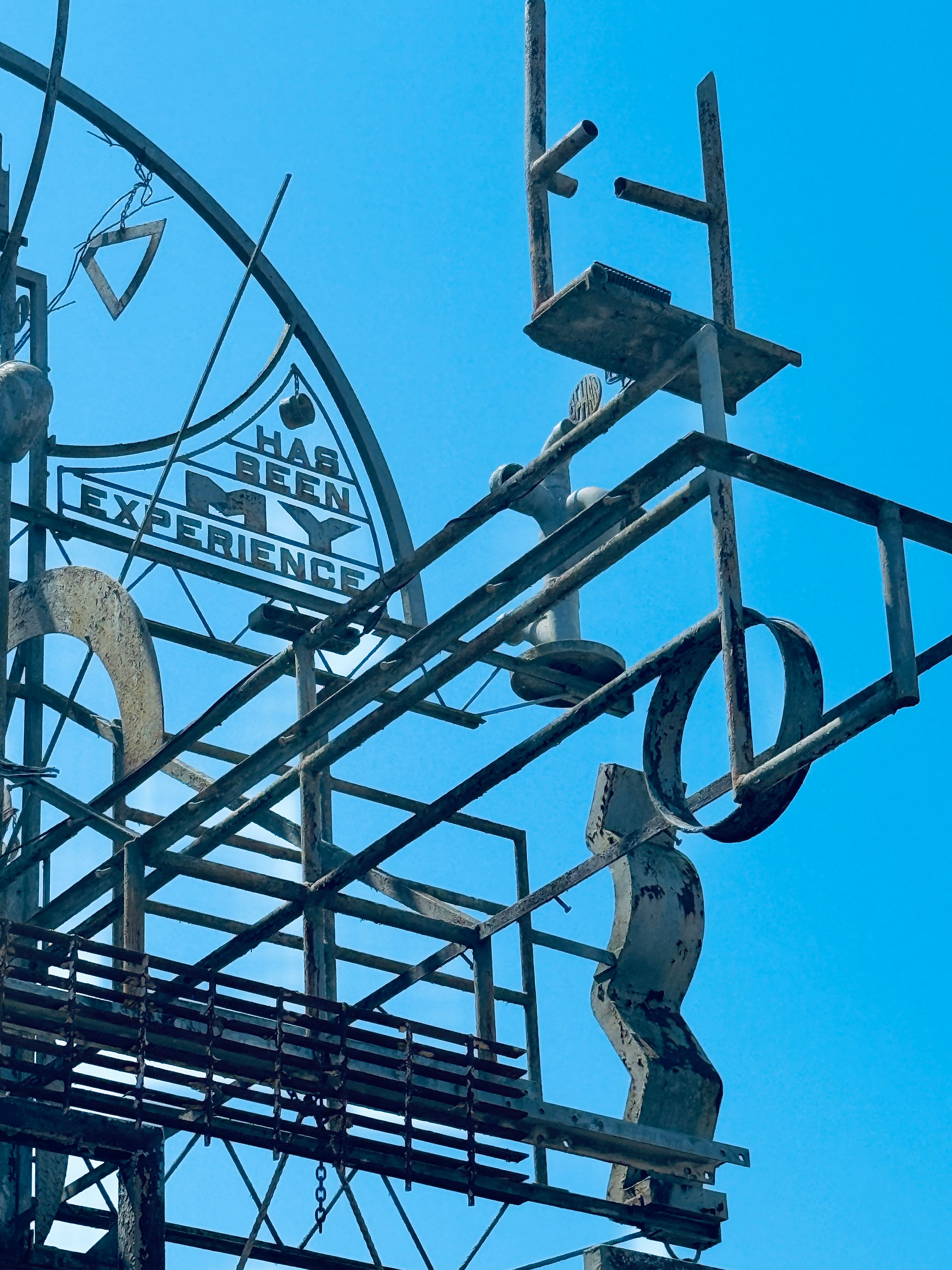
It has been my experience...at the Mindfield Cemeter 
A silo takes on a whole new meaning 
Billy Tripp's Mindfield Cemetery
The Mindfield Years Vol. 4, My Year of Deena. Good-bye to Dad…[& to Mom], Book 4 Postlude, is written after his father passes and he is beginning one of the largest projects to date, reconstructing a water tower that was brought in from Kentucky. Like all of the sculptures and the various aspects of himself, the water tower has a name – Deena. And as he works on her he assumes the mantle of Death. Death is truly a companion to Tripp. It informs his thoughts, it reminds him daily that life is short and precious, and that grief can be overwhelming but a catalyst as well. Billy says when writing this book, he was so lost, sometimes unable to muster the strength to go on with his projects. And haven’t we all felt that way when grieving the loves of our lives? Can’t we all see ourselves desperate for just one more conversation with them?

And I wonder: there will come a time when that moon will be here, & I won't. Now: upon the Sands of Foundation I try, like most mornings I try to do, to leave the un-worth of sleep's forgetfullness, & to climb back into a day's worth or remembered why. Why am I alive? Who am I to live? These askings get answered in work's work, for me. - The Mindfield Years, Vol. 4

What’s remarkable is how Tripp chooses to use the power behind his anguish. As a cenotaph you cannot find a more expressive memorial than this! The water tower has several outpourings of love to Charles and Mabel (A life of one, In Honor of Mom & Dad), and the largest tower on site is a monument to his father. One project says, "And now our lives without US," and another, “And and so now begin your life without him Billy.” Billy says that the stuttering is intentional; he found himself stuttering, struggling, to move forward with life and begin again without his best friend by his side. The arms and hands you see are outlines of his father’s arms traced by Billy before his death. The heartbreak is real and palpable. “Deena” is an outpouring of grief so monumental it needed thousands of empty gallons to contain it.

Mom & Dad, at the Mindfield Cemetery 
And now our lives without US, at the Mindfield Cemetery 
Tripp's old truck hood is now a sign honoring his parents. 
Below his father's memorial Tripp stutters with his anguish. 
Deena watertower in Mindfield Cemetery 
Billy Tripp's father's memorial at Mindfield
The Mindfield Cemetery isn’t all about Death, however. Throughout there are celebrations of life as well (and one ladder was even named Life!). There are reflections on his boyhood and brothers, private revelries, a dedication to his wife Beth (who he calls his Mindfield Interpreter to City Hall), and tributes to some of the authors who have informed so much of his writing style and world view (Tolstoy, Shakespeare, Thompson). He is especially moved by books on exploration. After reading Charles Lindbergh’s Spirit of St. Louis, he found a plane and created his own Spirit of Brownsville (small town large mind mostly maybe). One of his favorite authors, William Least Heat-Moon, figures most prominently – the steel canoe that was used in his book River Horse to travel across the US was given to Billy after they corresponded with one another, and it is now the centerpiece of Billy’s own tombstone, where his ashes will be interred after he passes.

The Spirit of Brownsville at the Mindfield Cemeter 
Billy Tripp's gravemarker at the Mindfield Cemetery. 
Some of Billy Tripp's favorite authors and a life message at the Mindfield 
Billy Tripp's wife Dr. Beth Shaw Tripp is his "Mindfield Interpreter" 
Billy's brothers hands and feet at the Mindfield Cemetery 
Melted iron becomes art
From a Sacred Sites perspective, I find this place intensely spiritual yet complicated. How interesting that Tripp is drawn to churches and steeples and has created a hallowed space, yet he’s not so sure there is an afterlife. This is at the crux of his work, one of the true signs of his inner conflict. Yet, there's no denying this is a cathedral, even if it's an unexpected one! For a fantastic perspective on the Mindfield that reaches to the heavens, watch Ken Heron's documentary using drone footage.

When Billy passes, the Kohler Foundation will assume control of the Mindfield Cemetery and its care in perpetuity and may even do so beforehand if he no longer feels he can work on a new project. At this writing Tripp is 70 years old and at some point, the taxing work may not be possible anymore, but he will continue his writing; he will always need an outlet.
Here are two pieces that hang from his future grave marker and move with the wind:

Look around you, Billy Tripp, at all you have accomplished. At one time you may have been lost with grief. But now you are found, and I guarantee you will never EVER be forgotten.

My very special thanks to Billy for his kindness in going out of his way for a wonderful tour and for the great conversation! Thank you Brandy Burnett for sharing your fantastic pictures! And I dedicate this to my brother Bob whose camera I inherited and who would have been delighted with the subject.
References:
One of a Kind Mindfield and Master Barber Shop and Menagerie Museum | SPACES Archives


Great Work Lisa! I want to see this place ...
Wow, I literally cried reading this article multiple times. Lisa, your writing conveyed the deep sense of loss and heartache that pieces of Mr. Tripp's art capture so honestly. I will now be watching all the provided films and visiting this monumental monument hopefully soon. Thanks for sharing such special and sacred places!
What a fascinating article on an amazing place and man! I love reading about the "obsessions" that become our lives. This was such a reminder of the purpose of our art as an outlet for our lived experience. I'll think of Mr. Tripp. Such an inspiration.