

Nashville Holocaust Memorial
If you like this post, please like and share so that others may discover it. Thank you!
Gordon Jewish Community Center
801 Percy Warner Blvd., Nashville, TN 37205
Enter the parking lot and look to your left, next to the Adventure Center. The tour begins at the three copper walls.
For information on group tours, please contact Marsha Raimi, nashvilleholocaustmemorial@gmail.com

The Holocaust is a disturbing, unfathomable fact, and now 80 years later there are precious few survivors alive to tell their tale. But we must talk about the Holocaust, because the reality was so horrible that it must never, ever be repeated. On top of that, there are those who claim it never happened at all! And so, in the US we are left with the History Channel to show documentaries on the Nazis, and a moving museum in DC to explore it. But what if I were to tell you that right here in Tennessee there is a memorial dedicated not only to educating the public about the Holocaust, but also remembering the Tennesseans who survived it, and honoring those who did not. It is a tribute told through art and architecture that is a moving and a grave plea.

It was an appropriately overcast, rainy day when I first saw the Nashville Holocaust Memorial. Organized by Historic Nashville, Inc., our tour of the memorial by docent Marsha Raimi was meant to be informative, evocative and contemplative. It was all three and so much more.
Imagine this: You, your relatives and community are hunted, dehumanized, denied your means of income and all personal rights. If you're lucky you have hidden some assets. Do you have the courage to try to flee if you can, even if this means leaving family and friends behind? What are your options, if any? There are few countries willing to provide sanctuary, as outside nations and communities don’t share your sympathies or are unable to absorb the financial burden. If you're horribly unlucky you are rounded up with others, stripped of your belongings and placed in horrible conditions. In short, death stares you intently in the face. How do you react to these conditions? How do you face your fate?
Our goal is to work towards creating a world where all of us will live free of intolerance, hatred, prejudice and indifference… We remember and learn from the past; our present actions will determine the future we create.” – Nashville Holocaust Memorial website
The Nashville Holocaust Memorial is on the grounds of the Gordon Jewish Community Center, which donated the land after Survivor Esther Loeb approached Felicia Anchor, a child of Survivors, to create a memorial. Funds were raised, and in October 2006, the Memorial was dedicated with Mayor Bill Purcell, Congressman Jim Cooper and many others in attendance.

REMEMBER (ZACHOR)
The Memorial is the first thing you see to your left when you enter the parking lot at the Gordon Jewish Community Center. There’s a metal triptych that says Nashville Holocaust Memorial and a large round stone in front of it that has the Hebrew word Zachor – Remember - written on it. This is the word that will set the tone for the rest of your tour. The number 5766 is the Hebrew date for 2006 and refers to the year the memorial was commemorated. A path leads you to the left to begin. I suggest grabbing a brochure or listening to the guided audio tour, as the artwork and meaning of the site beg for exploration and interpretation.

The Butterfly Tree at the Nashville Holocaust Memorial 
The Butterfly tree, Nashville Holocaust Memorial 
The Butterfly Tree sculpture, Nashville Holocaust Memorial 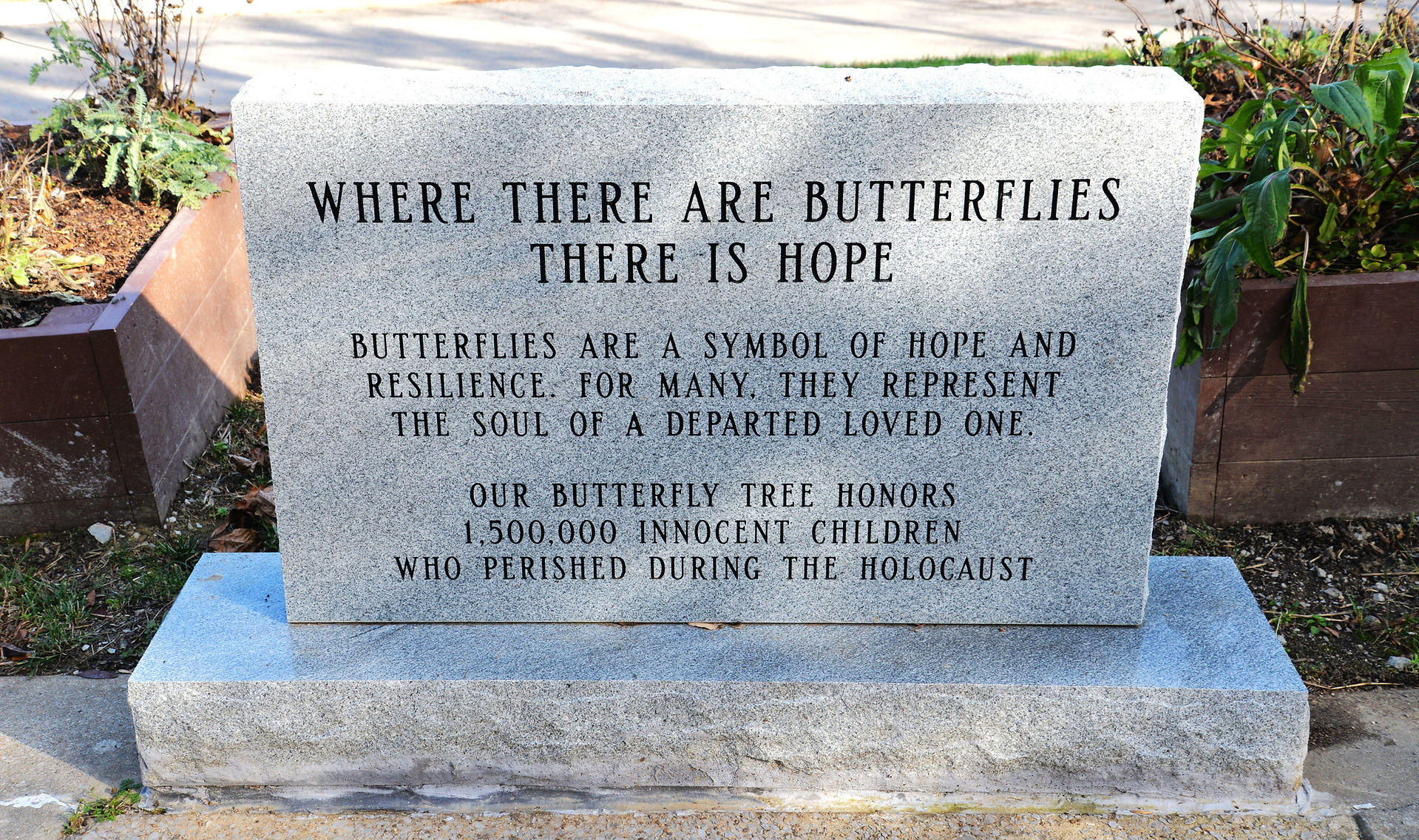
Butterflies of Hope, Nashville Holocaust Memorial
The path leads to a lovely sitting area around a sculpture of a tree, the most recent addition to the Memorial. This is called the Butterfly Tree, and its abstract shape and leaves are meant to honor the 1,500,000 children that were killed during the Holocaust. This may be the hardest part of the entire memorial for some, a fact that many people either do not know or don’t wish to contemplate. But the Nazi regime did not discriminate between the young or old; all Jews regardless of age were to be annihilated. The Hebrew name for the Holocaust is Shoah or ‘catastrophic destruction,’ and there is no better description. The Nazis rounded up and killed six million through mass shootings and in extermination camps with names like Auschwitz-Birkenau, Treblinka and Dachau using poison gas chambers.

After a short walk you’ll come upon a wall listing the nations and cities where the survivors and refugees came from who made it to Tennessee after the Holocaust. They fled from Germany, Lithuania, Poland and other European countries and were able to come to Nashville to start new lives. As many as 200,000 Jews survived the war inside the concentration camps, and another estimated 200,000 Jews hid across Europe and survived.
One of the many things I pondered was this: That people were able to find within themselves the strength and will either to survive concentration camps or to escape certain death by leaving everything they knew and loved behind. Isn’t that incredible, to find such courage in the face of suffering and overwhelming fear? Viktor E. Frankl, the renowned psychiatrist who himself survived concentration camps, perhaps says it best:
We must never forget that we may also find meaning in life even when confronted with a hopeless situation, when facing a fate that cannot be changed. For what then matters is to bear witness to the uniquely human potential at its best, which is to transform a personal tragedy into a triumph, to turn one’s predicament into a human achievement. When we are no longer able to change a situation – just think of an incurable disease such as inoperable cancer – we are challenged to change ourselves.” – Victor E. Frankl, “Man’s Search for Meaning”
The Nashville Survivors and Refugees certainly faced challenges, as they were forced to flee to Tennessee, become citizens and somehow reimagine their lives while knowing that so many others couldn't. Certainly, their pain and suffering were transformed into the creation of this beautiful park, and that is truly an achievement of note.

We know that from 1941 to 1945 Nazi Germany decimated two-thirds of Europe’s Jewish population. Nazis accused Jews of being “the embodiment of everything that was wrong with modernity,” allegedly controlling the Soviet Union and Western powers. Other groups were also targeted for ethnic cleansing, including 200,000 Roma, 3.3 million Soviet prisoners of war, and 100,000 Polish civilians. Sexual orientation, political ideologies, Free Masons and people of color were targets, and it was not only Jews but also Roman Catholics and Jehovah's Witnesses who were murdered. 300,000 people with mental and physical disabilities were either euthanized, forcibly sterilized or committed to hospitals. In Poland and the Soviet Union 13 million were brought to Germany to act as forced labor, and hundreds of thousands died from abuse and inadequate food and medical treatment. East European women were trafficked to German soldiers in military and camp brothels to serve as sex slaves. At least 16,000 suffered through medical experiments so horrifying it resulted in the Nuremburg Code of medical ethics. The scope of suffering was unimaginable.
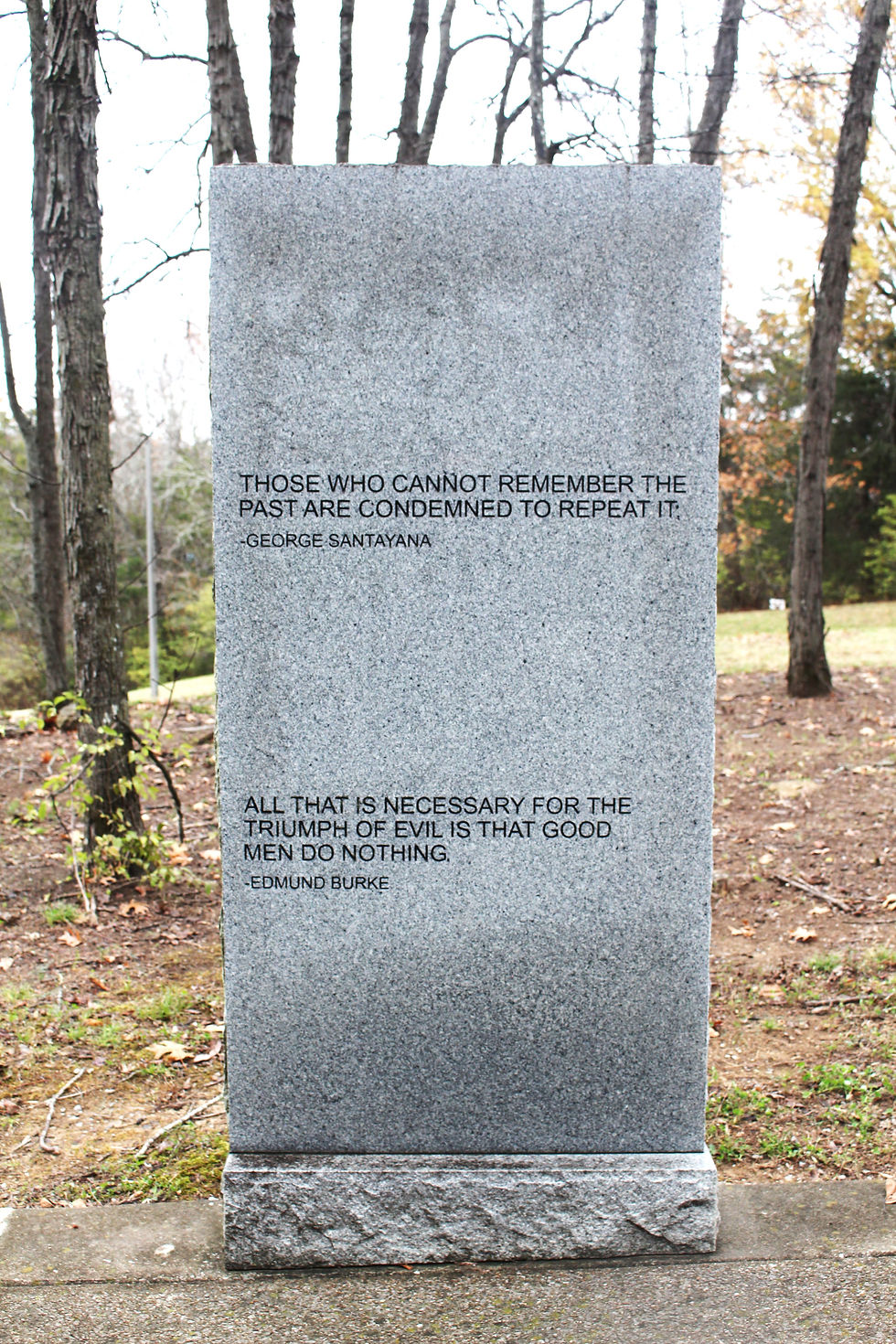
What is our personal responsibility to injustice? Even now there are people and cultures under immense pressure, where genocide is taking place, where entire ethnic groups are the subject of such intense discrimination that they are tortured, killed, starved out, or made to disappear. As human beings how are we to respond? Will history remember us for our lack of compassion, or will we choose to open our hearts and act against persecution? Consider the fact that genocide takes a lot of people to accomplish. In the case of the Holocaust, that translated to a quarter of a million Germans who were directly involved in the killing, and millions of Germans (and non-Germans) who allowed this to happen through spoken or silent consent.
When anyone becomes the victim of hatred and persecution we must not and cannot turn away. The price for indifference is too high.” – Elie Wiesel

When you come to the Main Plaza, you’ll see 12 walls that bear the names of victims of the Holocaust, inscribed here by their surviving families to honor and remember them. As the guide states, “For some, this Memorial is their only place of remembrance, having perished at the hands of Nazi oppression with no grave.” The Nashville Holocaust Archival Project gives you the opportunity to click on each individual’s name to learn more about them, including pictures and personal memories by family members. What a lovely project! It humanizes the victims and survivors, and reminds us they were our neighbors, not just statistics.
The collections of stones you see at the base of the walls and other areas are part of the Jewish tradition of leaving a sign that you have visited those who have passed and shared your thoughts and prayers. When I saw this during a visit to the Temple Cemetery in North Nashville I thought this was a beautiful way to remember those you loved.

The scupture of a book representing the 6 million Jews killed during the Holocaust 
The Ner Tamid or Eternal Light of faith 
The book sculpture at the Nashville Holocaust Memorial 
The book sculpture and 12 walls of victim's names
The final and most eye-catching part of this sculpture park is a large book, its patina verdigris, the pages torn and missing representing the deaths of the six million Jews during the Holocaust. What a thoughtful sculpture, such a moving representation of the lives that were ripped from this world or scarred forever. In front is the Eternal Flame or Ner Tamid, the light that shines to represent Faith, and next to it is a bowl with more stones. As I leave a stone in respect I’m reminded of my visits to memorials and museums for the Trail of Tears. The Holocaust Memorial, like Cherokee Removal Memorial Park in Birchwood, Tennessee, puts names to those who were oppressed. It asks us to face the ugly side of humanity, not to turn our backs, and instead acknowledge the real people and lives affected by this tragedy. Eighteen seats are arranged for contemplation representing the survivors who contributed to this Memorial. Eighteen is also the numerical value of the word Life in Hebrew. Despite everything the Survivors went through, I find this an amazing life affirming triumph.

There are Sacred sites and memorials that stay with you long after your visit and this was certainly one for me. I would highly recommend a visit to this site, as well as the phenomenal Belz Museum of Asian and Judaic Art in Memphis which features testimonials of survivors of the Holocaust, items from Nazi Germany such as a giant flag captured in an extermination camp, and art by Jewish artisans. If you’re a cemetery fan be sure to visit the Temple Cemetery in Nashville; it has striking monuments and a fascinating history you can read more about here.
For information about the Nashville Holocaust Memorial including a guide, history of the Holocaust and directions be sure to visit the website at The Nashville Holocaust Memorial.
Please consider a donation for the upkeep of the Memorial. Send donations to:
Nashville Holocaust Memorial
801 Percy Warner Boulevard
Nashville, TN 37205


Thank you, Lisa, beautiful article. Perhaps the collective wound of the Jewish population is so understandably great that some are willing to turn a blind eye to Israel's treatment of Palestinians. The very same horrors and devastation European Jews endured are now being handed out in Gaza and the West Bank. In the name of security. Shame on Israel. The oppressed has become the oppressor. One of my favorite organizations, "Jewish Voice for Peace," says, "not in our name." And yet, it seems too many have forgotten, and history is indeed repeating itself.